Disposal Rules
What Can Go in a Dumpster in Sarasota County? The Full List
A Sarasota operator's accepted and prohibited materials list for Sarasota and Manatee County — what loads clean, why yard trash rides separately, and where the banned items actually have to go.
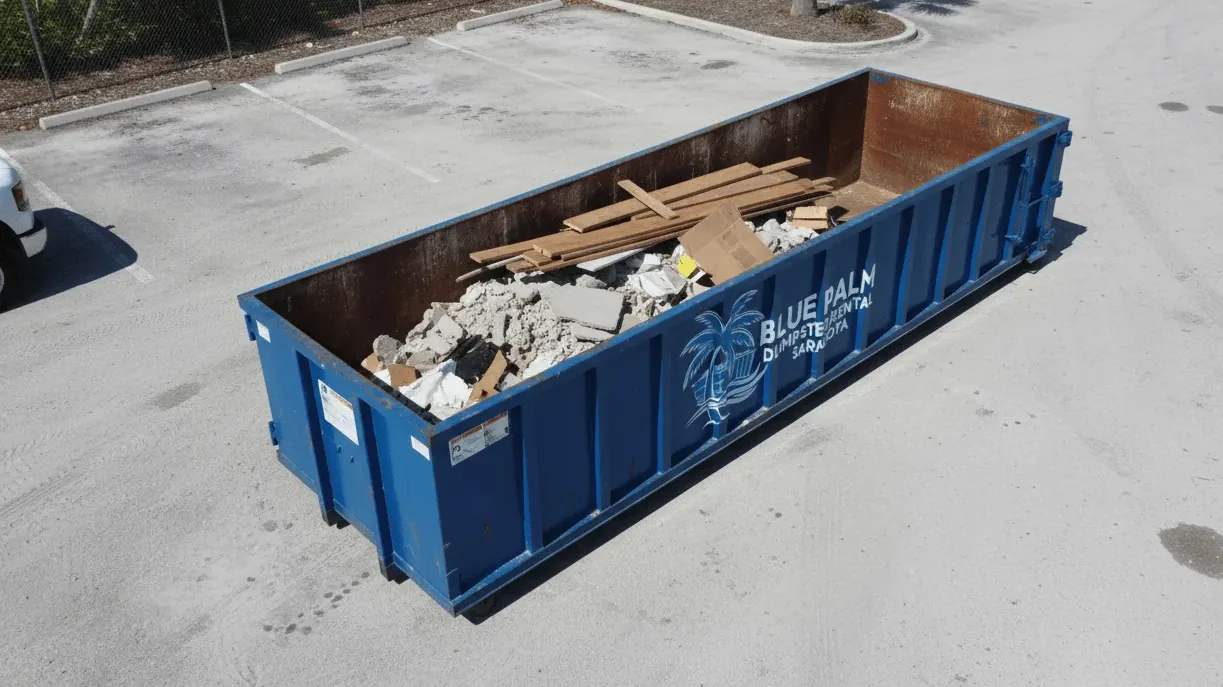
Ask ten crews on the Suncoast what goes in a roll-off and you will get ten answers, most of them close enough to get somebody a handling charge at the scale. The honest version is short: nearly all solid construction and demolition debris and nearly all household junk is fine. What gets loads rejected here is a narrow, predictable list — liquids, chemicals, pressurised cylinders, anything with a refrigerant charge, tires, and above everything else asbestos. Add to that a Florida quirk that catches people from out of state every single week: yard trash is not solid waste in this state, and mixing the two turns a clean load into an expensive one.
Our yard sits on the Manatee side of University Parkway, so we run both counties daily. This is written for a region with two solid waste systems, not one.
The master list: accepted, prohibited, and where the rest goes
| Material | Accepted? | Where it goes instead |
|---|---|---|
| Drywall, lumber, trim, plywood, framing | Yes | — |
| Concrete block, stucco rubble, brick, mortar | Yes — usually a dedicated heavy box | — |
| Terrazzo, ceramic and porcelain tile, thinset | Yes — heavy, size down | Intact mid-century terrazzo is worth a salvage call first |
| Shingles, underlayment, concrete and clay tile roofing | Yes | — |
| Flooring, carpet, pad, cabinetry, countertops, doors | Yes | — |
| Furniture, general household junk, boxes, clothing, toys | Yes | — |
| Insulation, soffit, fascia, screen and framing from a lanai | Yes | Aluminium frame is worth pulling for scrap |
| Yard trash — limbs, palm fronds, trunks, brush | Separate clean load only | Yard waste or mulching facility, never mixed into a C&D load |
| Clean fill dirt, sand, sod, rock | Ask first — must be its own load | Dedicated clean-fill disposal, weight-limited |
| Appliances without refrigerant (range, washer, dryer) | Yes | — |
| Refrigerators, freezers, window and split AC units | No | Certified refrigerant recovery, then scrap or county appliance drop-off |
| Mattresses and box springs | Usually yes — declare them | Often segregated and surcharged at the facility, so tell us the count |
| Electronics, monitors, CRT televisions | No | Sarasota County or Manatee County e-waste collection |
| Tires, on or off the rim | No | Tire retailer or county tire collection |
| Batteries — car, marine, lithium, rechargeable | No | Household hazardous waste drop-off or a scrap yard |
| Wet paint, stain, solvents, thinners, adhesives | No | County household hazardous waste drop-off |
| Gasoline, diesel, motor oil, antifreeze, brake fluid | No | County household hazardous waste drop-off |
| Pool chemicals — chlorine, shock, acid, algaecide | No | County household hazardous waste drop-off, kept separate in transit |
| Pesticides, herbicides, fertiliser concentrates | No | County household hazardous waste drop-off |
| Propane tanks, oxygen and any pressurised cylinder | No | Exchange programme or hazardous waste drop-off |
| Medical, biohazard and sharps waste | No | Licensed medical waste handler |
| Contaminated or petroleum-stained soil | No | Testing, then a permitted facility under Florida DEP oversight |
| Asbestos-containing material, any form | Absolutely not | Licensed abatement contractor and a permitted disposal cell |
Yard trash is a separate load in Florida. This is not optional.
Florida regulates vegetative debris as its own waste stream, distinct from solid waste, and it is handled at yard waste and mulching facilities rather than mixed into the construction stream. The practical effect on your job is simple: vegetative debris rides as a clean load, by itself. Throw six palm fronds and a live oak limb into a container full of drywall and cabinet doors and you no longer have a yard waste load — the whole thing gets reclassified at the scale and priced as mixed debris. It works the other way too. A tidy brush load with one bag of demo trash buried in it stops being clean.
Our local tree mix is live oak, sabal palm, Australian pine and Norfolk Island pine, and people consistently misjudge it. Palm fronds and trunk sections are bulky and wet but comparatively manageable; live oak limbs are dense hardwood and will put a container over weight long before it looks full. A mixed yard clears out heavier than anyone expects. If you have both a tree job and a remodel running, book them as two containers or two pulls — that is what our yard waste removal service is set up to do, and it almost always lands cheaper than paying to have one contaminated load sorted.
Prohibited, and the reasons behind it
The banned list is not arbitrary. Liquids leak through the container floor onto a driveway and into the storm drain. Cylinders and lithium batteries start fires in a compactor. Refrigerants must be recovered by a certified tech before a shell can be scrapped. Tires are banned from landfill disposal statewide.
Two of these are Sarasota specialities. The first is pool chemicals. Half the garages in this county have a shelf of old chlorine tabs, shock, muriatic acid and algaecide left by a previous owner, and on an estate cleanout they turn up constantly. Oxidisers and acids do not belong in a steel box in August. Set them aside for the county. The second is marine batteries.
Rules change, sites change, and acceptance lists get revised. Before you haul anything unusual, confirm current requirements with Sarasota County or Manatee County directly.
Asbestos and lead in pre-1980 Sarasota stock
This is the one that costs real money if it is handled wrong, and Sarasota carries a deep stock of older housing — Ringling-era Mediterranean Revival, 1950s and 60s block homes, and the Sarasota School houses with their terrazzo and flat roofs.
In pre-1980 construction, assume asbestos is present until testing says otherwise in: 9x9 and 12x12 floor tile and the black mastic under it, pipe and duct wrap, popcorn and textured ceilings, cement-asbestos siding, and roofing felt. Under carpet in a mid-century home you will often find terrazzo — good news — but where you find old tile instead, stop and test. Pre-1978 homes also fall under the EPA's Renovation, Repair and Painting rule for lead paint, which governs how disturbed painted surfaces are contained and cleaned.
Asbestos in Florida is regulated by Florida DEP alongside the Florida Department of Health, and demolition work generally triggers a NESHAP inspection and written notification before anything comes down — often even when no asbestos is found. Removal is licensed abatement work with its own disposal path. We cannot take asbestos-containing material in any container, in any quantity, wrapped or not. Get the survey done before you schedule the demolition debris container, not after the ceiling is on the floor, and confirm current notification thresholds with the agencies because these requirements are revised periodically.
Household hazardous waste: where it actually goes here
Leftover paint, solvents, fuels, automotive fluids, pesticides, pool chemicals, batteries and fluorescent tubes all go to a Sarasota County or Manatee County household hazardous waste drop-off. Worth saying plainly, because visitors and new residents ask: there is no retail paint take-back programme in Florida. PaintCare does not operate in this state, so the paint store will not take your half-used cans back. The county site is the answer. Our Sarasota County recycling and disposal guide walks through the streams in more detail.
Two counties, two systems
Sarasota County and Manatee County run separate solid waste operations, accept different materials at different sites, and keep separate hours and residency rules. A material accepted at a Manatee facility is not automatically accepted at a Sarasota one, and the cities — Sarasota, Venice, Bradenton, North Port, Longboat Key, Palmetto — layer on top of that. If you live in one county and work in the other, which happens constantly around Lakewood Ranch, confirm before you load. The same split applies to right-of-way container permits.
The odd categories
Treated lumber, dock and seawall material. Pressure-treated deck boards, dock stringers and old seawall cap timber are generally acceptable as C&D, but they cannot go into a clean wood or mulch stream — the preservative rules that out. Keep treated material with the mixed debris and tell us it is in there.
Boat and marine waste. On this coast it is a real category. Old fibreglass hull sections, rotted dock lumber, cracked pilings, marine batteries, hardware and rigging turn up on waterfront cleanouts constantly. Fibreglass and dock lumber can generally go in a mixed container; marine batteries cannot, and neither can fuel left in a tank. A whole vessel is not container material at all — that is a titled-hull disposal problem with its own process.
Electronics and CRTs. Both counties collect them; neither wants them in a roll-off. CRT monitors and televisions are a separate stream because of the leaded glass.
Mattresses. Accepted, but declare the count when you book. Facilities frequently pull them out and handle them separately, and the surcharge lands on the load either way.
Storm debris changes the whole system, temporarily
When a declared event hits — the way Helene's surge and Milton's wind did two weeks apart in 2024 — the normal rules bend. Emergency right-of-way collection stands up, sorted into distinct streams at the curb: vegetative debris, construction and demolition, appliances and white goods, electronics, and household hazardous waste. Those piles must stay separated or the contractor leaves them. That programme does not cover material generated by a contractor doing paid repair work, which is where a private container comes in. Our storm surge cleanup guide covers the sequencing, and post-event guidance from the county should be checked each time, because the rules issued after one storm are not the rules for the next.
Pull the scrap metal first
Metal is the one category where sorting pays you instead of costing you. Before a tear-out, pull the copper, appliance shells, ductwork and steel. Two local streams are worth naming: lanai and pool cage aluminium, which comes off in long clean extrusions after a wind event, and impact window frames — an impact upgrade leaves a pile of clean aluminium frame stock once the glass is separated. Glass is not scrap; frame is. Sorting it out ahead of the pull also lightens a load that is otherwise dense enough to matter — see how we handle concrete and heavy debris.
Stormwater and the bays
Nothing gets stockpiled where runoff reaches the water. Sarasota Bay, Roberts Bay and Phillippi Creek are watched closely, and staging debris on a swale or over a storm inlet during a summer downpour is how a routine job becomes a code complaint. Keep piles off the drainage path and tarp anything that can blow or wash. On barrier island lots with short shell driveways that takes planning, which is why we talk through placement and driveway protection before the truck rolls.
What happens when prohibited material shows up
Nothing dramatic, just expensive. If a driver spots a prohibited item at pickup, the container does not move until it comes out — that is a wasted trip and a delayed schedule. If it is found at the scale, the facility charges a handling or contamination fee that passes straight through, or refuses the load outright and sends it back. Asbestos found in a load is a different order of problem entirely, with regulatory exposure that lands on whoever generated it. And a load of construction debris with yard trash mixed in simply gets reclassified and priced as what it actually is.
All of it is avoidable with one call before you load. See our construction dumpster rental and roofing container pages for job-specific guidance, and the southwest Florida construction debris guide for how the streams fit together on a larger project.
Not sure whether it can go in the box? Just ask. Blue Palm Dumpster Rental Sarasota has been running roll-offs across Sarasota County, Manatee County and the Suncoast since 2017, we know what each county's facilities will and will not take this month, and we will tell you straight before you fill a container with something that has to come back out. Call (941) 413-2932 for same-day or next-day delivery, or start with our dumpster sizing guide if you are still working out which box the job needs.
Questions this guide did not answer? Call (941) 413-2932. We would rather spend two minutes on the phone than have you order the wrong container.