
Roofing
Roofing Tear-Off Dumpster Size Guide for Sarasota
A Sarasota roofer's sizing guide: squares and layers, real weight per square, why concrete and clay tile run three to four times a shingle square, and the container that fits each job.
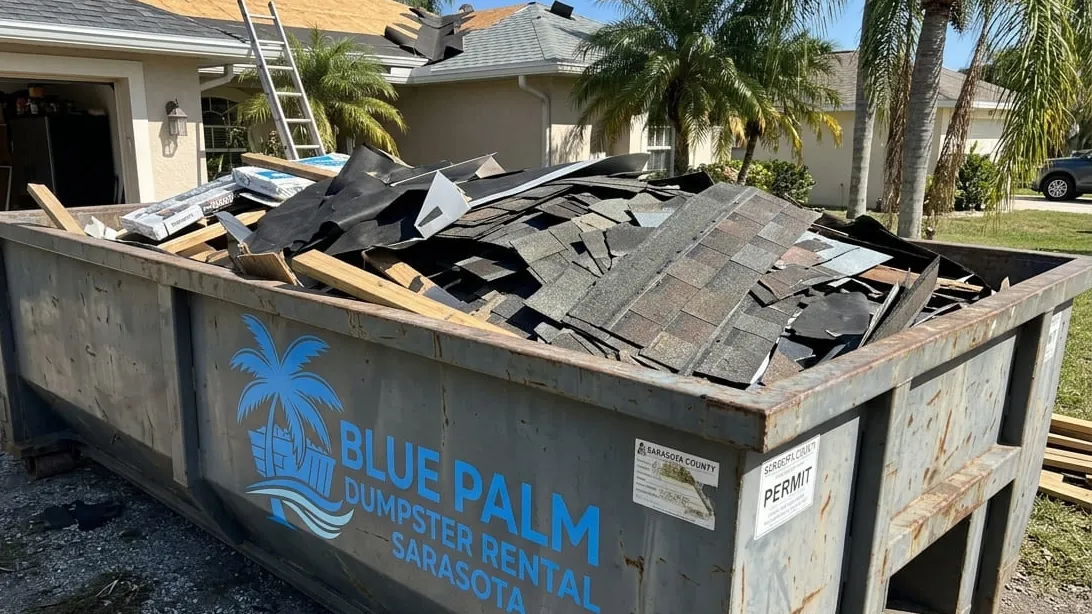
Roofing is the one job where the usual sizing conversation goes out the window. A tear-off does not fill a box. It sinks it. I have watched a crew put a whole Palmer Ranch roof into a 20 yard can, still be able to see the floor plates through the debris, and have that same can sitting overweight for the truck.
So: on a re-roof you are buying tonnage, not volume. The yards are just the shape it comes in. Here is how we size roofing boxes on the Suncoast, and where this market breaks every rule in a national sizing guide.
Squares and layers, not square footage
A square is 100 square feet of roof surface, and it is the only number I need from you. A 2,400 square foot ranch off Bee Ridge is not a 24 square roof — pitch, overhangs and hips push the actual surface up, so it is more like 27 or 28. Your roofer already knows that figure. Ask for it.
The second number is layers. Plenty of 1970s and 1980s stock around Gulf Gate, South Gate and the older Bradenton neighbourhoods is carrying two, and two layers is not a little more debris — it is double, plus felt, plus whatever rotten decking comes off with it. Third is material, and in this market that is the one that decides everything.
What a square actually weighs
Working ranges, not laboratory numbers. Add roughly ten percent for underlayment, felt, drip edge, flashing, nails and deck sheathing.
| Material | Approx. weight per square (per layer) | Where you see it here |
|---|---|---|
| Three-tab asphalt shingle | 200–250 lb | Older tract housing and rentals |
| Architectural / dimensional shingle | 350–450 lb | The default on almost anything re-roofed in twenty years |
| Clay tile | 800–1,000 lb | Mediterranean Revival, bayfront, higher-end Lakewood Ranch |
| Concrete tile | 900–1,100 lb | Palmer Ranch, The Meadows, Longboat Key, 1980s–2000s builder stock |
| Standing seam or 5V metal | 50–150 lb | Siesta, Lido and Casey Key, newer custom builds |
| Modified bitumen / built-up flat | 300–700 lb | Mid-century flat roofs, commercial, low-slope additions |
Look at that spread. A 30 square architectural shingle roof is roughly six tons. The same 30 squares in concrete tile is closer to fifteen. That is not a bigger box — it is a different plan.
The Sarasota one: tile runs three to four times a shingle square
This is the single most expensive sizing mistake in this market, and it is usually made by someone who priced the job on shingle math.
Concrete and clay tile run roughly three to four times the weight of a shingle square. Tile is not niche here — it is all over the older and higher-end stock across Palmer Ranch, Longboat Key, Lakewood Ranch, the bayfront off the John Ringling Causeway and half the 1990s subdivisions east of I-75. It is brittle, so it does not stack; it breaks into wedges that void a lot of the box while still loading it to the axle.
If your roof is tile, throw the yardage habit out. Order small, order more than one, plan swaps. A tile job is closer to a concrete and heavy debris haul than a normal roofing load, and we schedule it that way.
Metal on the keys — light, bulky, and worth money
Metal is common on Siesta, Lido and Casey Key. It is the lightest roof you can tear off, but panels are long and bridge across the box instead of settling, so metal eats volume and almost no weight. Two things follow: you can use a bigger box than the tonnage suggests, and you should not be throwing it away at all. Clean steel and aluminium panels have scrap value — pull them, stack them, and let a scrap buyer take them before the container shows up. Same for copper flashing and valley metal on the older bayfront houses.
Two layers, three layers, and what is under them
On older stock — 1960s and 1970s Gulf Gate, Sarasota Springs, the villa neighbourhoods off Bahia Vista — a tear-off frequently finds a second layer nobody knew about. Multiply tonnage by layers, then add for decking. Rotten sheathing shows up on roughly a third of tear-offs here, because of what humidity does to a roof that has been leaking quietly for two seasons, and plywood is heavy.
The sizing table
Use squares, layers and material together.
| Material | Squares | Layers | Recommended container | Notes |
|---|---|---|---|---|
| Three-tab shingle | Up to 15 | 1 | 10 yard | Small ranch, garage or addition roof. Comfortable on weight. |
| Three-tab shingle | 15–25 | 1 | 15 yard | The forgotten size, and often the right one. |
| Architectural shingle | Up to 15 | 1 | 15 yard | Heavier per square than most people expect. |
| Architectural shingle | 15–30 | 1 | 20 yard | The most common re-roof order we run. Do not load past the top rail. |
| Architectural shingle | 30–45 | 1 | 30 yard | Watch tonnage, not the fill line. Large two-story stock. |
| Any shingle | 15–25 | 2 | 20 yard + planned swap | Double the debris plus felt and any bad decking. |
| Any shingle | 25+ | 2–3 | 30 yard + swap | Book the swap when you book the delivery. |
| Concrete or clay tile | Up to 10 | 1 | 10 yard | Will hit weight with room to spare. That is normal. |
| Concrete or clay tile | 10–20 | 1 | 10 yard × 2, or 15 yard staged | Never one large box. Two small hauls beat one illegal one. |
| Concrete or clay tile | 20–35 | 1 | 15 or 20 yard on repeat swaps | Three or four hauls is a correctly-planned tile job. |
| Metal | Up to 25 | 1 | 20 yard | Bulky and light. Scrap the clean panels first. |
| Metal | 25–45 | 1 | 30 yard | Panels bridge and waste space; break or fold them down. |
| Modified bitumen / flat | Up to 20 | 1–2 | 15 or 20 yard | Wet insulation board weighs far more than dry. |
The honest advice behind that table: a smaller box hauled twice beats one box you cannot legally move. The truck cannot lift an overweight can, the driver will not take it, and you are left in a driveway with a crew on the clock and a roof half open.
Why nobody should order a 40 for a tile tear-off
People see a 40 yard roll-off and assume it is the safe choice. On tile it is the worst one. A 40 is built for bulk with almost no weight. Fill even the bottom third with concrete tile and you are past what the truck can legally roll onto US-41 or over the Ringling Causeway. Then it sits — it cannot be emptied where it stands and it cannot be moved, so somebody climbs in and pulls material out by hand. I have had that phone call more than once. Our dumpster size guide and the broader what size dumpster do I need in Sarasota walkthrough lay the weight allowances out side by side.
Why so many Sarasota roofs are coming off right now
Three things drive the volume. Florida's property insurance market has pushed a sustained re-roof wave, with carriers scrutinising roof age at renewal and inspections turning into replacement requirements. The Florida Building Code governs the work, and in a coastal high-wind region that means wind-uplift resistance and a secondary water barrier on the deck — which is why a modern tear-off goes to bare sheathing rather than a lay-over. And the 25 percent rule turns what a homeowner calls a repair into a full replacement once the damaged area crosses that threshold on a roof section.
All three change, and often. Confirm current requirements with the Sarasota County or Manatee County building department, check code specifics at Florida Building, and take insurance questions to your carrier and the Florida Office of Insurance Regulation rather than a contractor's summary of them. Permitting is county-and-city specific too — see our Sarasota dumpster permit guide.
Hurricane season moves your booking date
Season runs June 1 to November 30. After a named storm the whole region books out at the same hour — roofers, adjusters, tarp crews and containers at once. In 2024 that happened twice inside three weeks: Helene's surge in late September, then Milton ashore at Siesta Key. Work normally scheduled in a week ran months. Calling early beats calling right. Our hurricane and storm surge cleanup guide covers the wider debris picture.
If insurance is paying, sequence it right
Do not let debris leave before the claim is documented. Photograph the roof from the ground and from the deck, close up and wide, keep a damaged shingle or tile in a bag, and open the claim before the tear-off starts. An adjuster cannot inspect a roof that is already in a container on its way to the scale. Order the box, but stage the work behind the claim.
Pre-1980 roofs: test before you tear
Roofing felt on pre-1980 buildings can contain asbestos, along with cement-asbestos shingle and some mastics and flashing compounds. If the building predates 1980, stop and have it tested rather than tearing it off and finding out later. Asbestos is regulated here by the Florida Department of Environmental Protection and the Department of Health, and this work generally triggers a NESHAP inspection and notification. Those rules get updated — confirm the current process with DEP before scheduling. We cannot accept asbestos-containing material in any container. It goes to a licensed abatement contractor and a permitted facility.
Condo and multi-family re-roofs
A large share of our roofing work is association work — re-roofs falling out of milestone inspection and structural integrity reserve study findings on Longboat Key, Siesta Key and downtown. Placement needs board approval and often fire marshal sign-off, because you cannot block a fire lane or a hydrant. Residents are still in the building, so the box has to sit where debris chutes reach it without landing beside somebody's lanai. These requirements have shifted repeatedly, so an association should confirm its current obligations with its attorney and engineer. More in our condo milestone and SIRS repair debris guide.
Placement, protection and the nail sweep
Set the box tight to the tear-off side — every extra step a loader takes with a shovel of tile is time you pay for. Keep it clear of the drip line so a downpour is not running into an open container and adding water weight. Protection boards go under the rails as standard; pavers and shell drives on the keys are short and unforgiving, and wet sandy ground gives way under a loaded truck. More in our driveway protection notes.
Two local access items. Live oak limbs: the hoist arm needs 20 or more feet of clear vertical space, and the mature oaks over Southside Village, Arlington Park and West of Trail routinely hang lower than that. Walk it before delivery day. And run a magnet sweep over the drive and lawn afterwards — a tear-off sheds thousands of nails, and they end up in tyres and bare feet.
Swaps, and never leave the deck open
On a big shingle job or any tile job, book the swap when you book the delivery. Next-day swap-outs are how a tear-off stays on schedule instead of stalling with a full box and a stripped roof. That matters more here than most places: the afternoon storm pattern is close to daily from June through September, and an open deck with dry-in incomplete at 3pm is an interior water loss by 4pm. Dry-in the same day you tear off. Our roofing dumpster rental service page covers what we bring and how we stage it.
Tell us squares, layers and material and we will tell you the right box — and if the honest answer is two smaller hauls instead of one big one, that is what you will hear. Call Blue Palm Dumpster Rental Sarasota at (941) 413-2932 for same-day or next-day delivery across Sarasota County, Manatee County and the keys, or send job details through our contact page.
Questions this guide did not answer? Call (941) 413-2932. We would rather spend two minutes on the phone than have you order the wrong container.