Permits
Dumpster Permits in Sarasota, FL: When You Need One and When You Don't
Most containers on the Suncoast need no permit, but the street, a state road, a condo board or a demolition changes that fast. Here is who to ask and what they want to know.
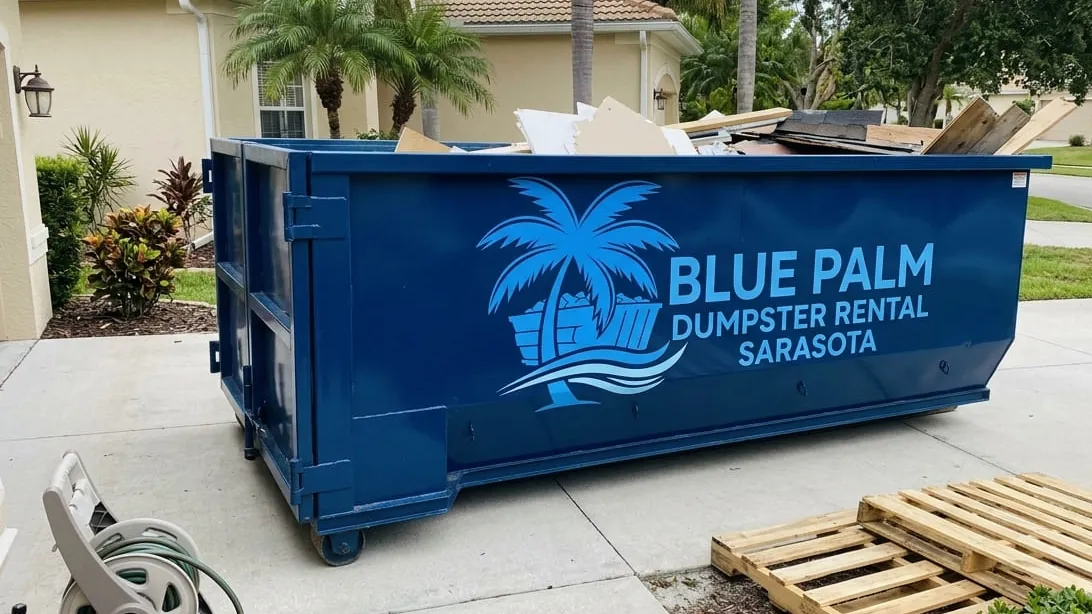
The question comes in almost every day, usually right before someone books: do I need a permit for this thing? Most of the containers we set on the Suncoast need no permit at all, a meaningful minority do, and the difference usually comes down to about fifteen feet of concrete — whether the box sits on your own driveway or out over the public right-of-way.
What makes it confusing here is not the rule. It is the number of separate rulebooks. Our yard sits on 33rd Street East, just north of University Parkway on the Manatee County side near the airport, and we run Sarasota County every day. That tells you most of what you need to know: two counties, two systems, and a half-dozen cities and towns underneath them that answer for themselves. Nobody should assume one answer covers the region, us included. Before you book anything that touches a public road, call the jurisdiction and confirm.
On your own driveway or private property: generally no permit
Most of the roll-offs we deliver go on a private driveway, and there you are usually not pulling any permit for the container itself. It is your property, the box sits entirely on it, and no travel lane, sidewalk or swale is obstructed. A garage cleanout in Gulf Gate, a kitchen remodel off Bee Ridge, a shed teardown out toward Myakka — driveway drop, no paperwork.
Two caveats. First, no permit for the container is not the same as no permit for the work — a dumpster parked in front of an unpermitted addition does not make the addition legal. Second, private property still has a landlord: in a deed-restricted subdivision, villa community, condo association or 55+ neighbourhood, the association is the authority that matters, and that is a bigger deal here than almost anywhere.
On a private drive our job is protecting the surface. Every delivery goes down on protection boards as standard, which matters on the pavers and thin-pour drives that are everywhere here. There is more in our guide to protecting a driveway during dumpster delivery, and our roll-off container service page covers how the truck places a box.
The street or the right-of-way changes everything
The moment any part of that container sits on a public street, in a swale, over a sidewalk or inside the public right-of-way, you are in permit territory. Depending on the jurisdiction it is a right-of-way use permit, an obstruction permit or a street occupancy permit — a real application with a real review, not a phone call.
Plan on lead time. These are not same-day approvals, and in season they are not next-day either. Reviewers generally want the address, exact placement, dates, duration, proof of liability insurance, and increasingly a traffic control plan with cones, reflective markings and sometimes a night barricade. On a narrow street with parking both sides, expect questions about emergency vehicle access.
If a street set is the only option, tell us at booking, not at delivery. Our contact page is the fastest way to start that early.
Two counties and a lot of separate jurisdictions
Here is the part people underestimate. Sarasota County and Manatee County run entirely separate permitting and solid waste systems. Inside those counties, the City of Sarasota, City of Venice, City of North Port, Town of Longboat Key, City of Bradenton and City of Palmetto are separate again, each with its own building department, its own right-of-way process and its own fee schedule.
So the answer for a bungalow off Ringling Boulevard is not the answer for a house four miles east in unincorporated county, or for a job in Palmetto. Lakewood Ranch straddles the county line, so two houses in one community can sit under different reviewers. Our service area map gives you the geography; jurisdiction is a separate question for the parcel.
| Where the container is going | Who you ask | What they typically want to know |
|---|---|---|
| Private driveway, unincorporated Sarasota County | Usually nobody for the container; county building department for the work | Whether the project behind the debris is permitted |
| Private driveway, unincorporated Manatee County | Usually nobody for the container; Manatee County building department for the work | Same — permit status of the job, not the box |
| Public street or swale, City of Sarasota | City of Sarasota right-of-way / engineering | Exact placement, dates, duration, insurance, traffic control and night reflectivity |
| Public street, Venice, North Port, Bradenton or Palmetto | That city’s own public works or engineering desk | Same categories, different forms, different lead time |
| Anywhere on Longboat Key | Town of Longboat Key — its own town, its own rules | Placement, duration, screening, working hours, construction-parking limits |
| On or over a state road (US-41, US-301, SR-72, SR-780) | FDOT district permitting, often alongside the local agency | Lane closure, sight lines, maintenance of traffic, insurance |
| Condo, villa or HOA common property | Association board or property manager, plus fire marshal where a fire lane is involved | Placement, fire-lane clearance, duration, working hours, surface protection, written approval |
| Demolition of a structure | Local building department, plus asbestos notification to the state | Demolition permit, utility disconnects, NESHAP inspection and notification |
Treat that table as a starting map, not gospel. Fees, forms and thresholds change, and the only current answer is the one the agency gives you this week.
A state road brings FDOT into it
Some of our busiest corridors are state roads. US-41, the Tamiami Trail, runs from Palmetto through downtown Sarasota to Venice; US-301, SR-72 (Clark Road) and SR-780 (Fruitville Road) are the same story. If a container, truck or work zone touches one, the Florida Department of Transportation has a say, usually in addition to the local permit rather than instead of it. Commercial jobs on 41 frontage are where this bites most. Confirm current FDOT requirements with the district office — they do get revised.
Call 811 before you dig, and know where the septic is
Digging, demolition, driving stakes or pulling a tree with the root ball means a locate ticket through Sunshine 811 first. It is free, it is state law, and two business days is the general expectation. Out east toward Myakka and on rural parcels off Fruitville and Clark, add what 811 does not mark: the septic tank, the drain field and the well head. A loaded roll-off truck will collapse a drain field. Stake them before we arrive.
The condo and HOA layer — the one that actually stops jobs here
In most markets the association is a footnote. Here it is often the whole permitting story. A container on association property — a condo lot, a shared villa drive, a courtyard — needs board approval, and frequently fire-marshal sign-off so it does not block a fire lane or hydrant. Nine times out of ten the approved spot is a marked parking area rather than a unit driveway, which changes the walk distance and sometimes the size we recommend.
Expect conditions: working hours, a hard cap on days, boards under the rails, no overnight loading, screening from the street. Get it in writing. A verbal nod from a board member on Thursday is not approval, and we have watched boxes get towed on Monday over exactly that. An email from the manager naming location and dates is enough.
55+ communities deserve their own line. Many cap how long a container may sit — short windows are common — which shapes the whole plan for an estate cleanout or downsizing move. If the cap is tight, take a bigger box for a shorter stay rather than a small one you swap twice; our size selection guide works through that trade-off.
The barrier islands are their own problem
Siesta Key, Lido Key, Longboat Key and Casey Key all have narrow causeway access, tight lots and short shell or paver driveways. Longboat Key is its own incorporated town with its own rules on placement, duration, construction hours and parking, and it enforces them. Coastal construction control line requirements and dune protection apply on the Gulf side, and seasonal traffic on Midnight Pass Road or Gulf of Mexico Drive decides what time of day a truck can get in and back out.
Demolition, asbestos and the paperwork behind the box
Taking a structure down is a permit, full stop — a demolition permit from the local building department, with utility disconnects verified first. Demolition also generally triggers a NESHAP asbestos inspection and notification before work begins, even when the survey comes back clean. Florida DEP and the Department of Health regulate asbestos here, and pre-1980 stock routinely carries it in floor tile and mastic, pipe and duct wrap, textured ceilings, cement-asbestos siding and roofing felt. Pre-1978 homes bring lead paint and the EPA RRP rule with them.
To be blunt: we cannot accept asbestos-containing material in any container. That is an abatement contractor's job with its own manifest and disposal chain. Once the structure is clean, our demolition debris containers handle the rest, and our notes on what can and cannot go in a container here cover the other exclusions. Confirm current asbestos and notification rules with DEP or the county health department before you schedule — those thresholds have been revised more than once.
The permits for the work itself
The container is the easy part. The building permit behind it is where the real timeline lives. Re-roofing is permitted work governed by the Florida Building Code's wind-uplift and secondary-water-barrier requirements, and the 25 percent rule pushes many repairs into full replacements — which is why our roofing tear-off containers stay busy. Impact window replacement, additions, structural changes and anything touching load paths are permitted work too.
Condo milestone inspections and structural integrity reserve studies add another layer. The repairs that follow — balconies, railings, walkways, spalling concrete, waterproofing, re-roofing — have their own structural permitting path and usually engineer-of-record involvement, and the debris schedule has to follow the phasing. We covered that in our piece on milestone and SIRS repair debris. Those requirements have changed repeatedly since Surfside, so an association should confirm current obligations with its own attorney and engineer, not with a dumpster company.
After a declared storm, the rules move
After a declared emergency — Helene and Milton in 2024, Ian in 2022 — jurisdictions often relax placement and duration rules, extend permit windows and stand up a separate debris programme with its own curbside rules. Those changes are temporary and differ by city and county. In that window, storm and surge cleanup containers cover what the curbside programme will not take on your schedule, and vegetative debris still rides as a separate clean load to a yard waste facility. Check the current orders; last storm's rules do not carry over.
Not a permit, but it will still stop the job
Half the placements that fail here fail for physical reasons, not legal ones:
- About 60 feet of straight approach for the truck to set and retrieve a box cleanly.
- 20-plus feet of overhead clearance — the container tips up before it rolls off.
- Low live oak limbs, everywhere in the older neighbourhoods and not negotiable.
- Short shell and paver drives on the keys and in the older mainland pockets.
- Sandy ground and a high water table — wet ground gives way under a loaded truck.
Send a photo of the spot when you book. Thirty seconds on your phone saves a wasted trip.
Talk it through before you book
Permitting on the Suncoast is not hard once you know which desk to call — it is only hard because there are so many desks. We run both counties and every city in between, and we will tell you straight whether your placement needs paperwork or whether the box should just go on the drive. Requirements change, so treat our read as a starting point and confirm with the relevant city, county or FDOT office before your delivery date. Call Blue Palm Dumpster Rental Sarasota at (941) 413-2932 and we will sort the placement, the size and the timing together.
Questions this guide did not answer? Call (941) 413-2932. We would rather spend two minutes on the phone than have you order the wrong container.