Pricing
What Actually Drives Your Sarasota Dumpster Rental Cost
A straight account of what moves the number on a Sarasota dumpster invoice — flat rate versus stacked fees, weight as the biggest variable, dry runs, island access and two county disposal systems.
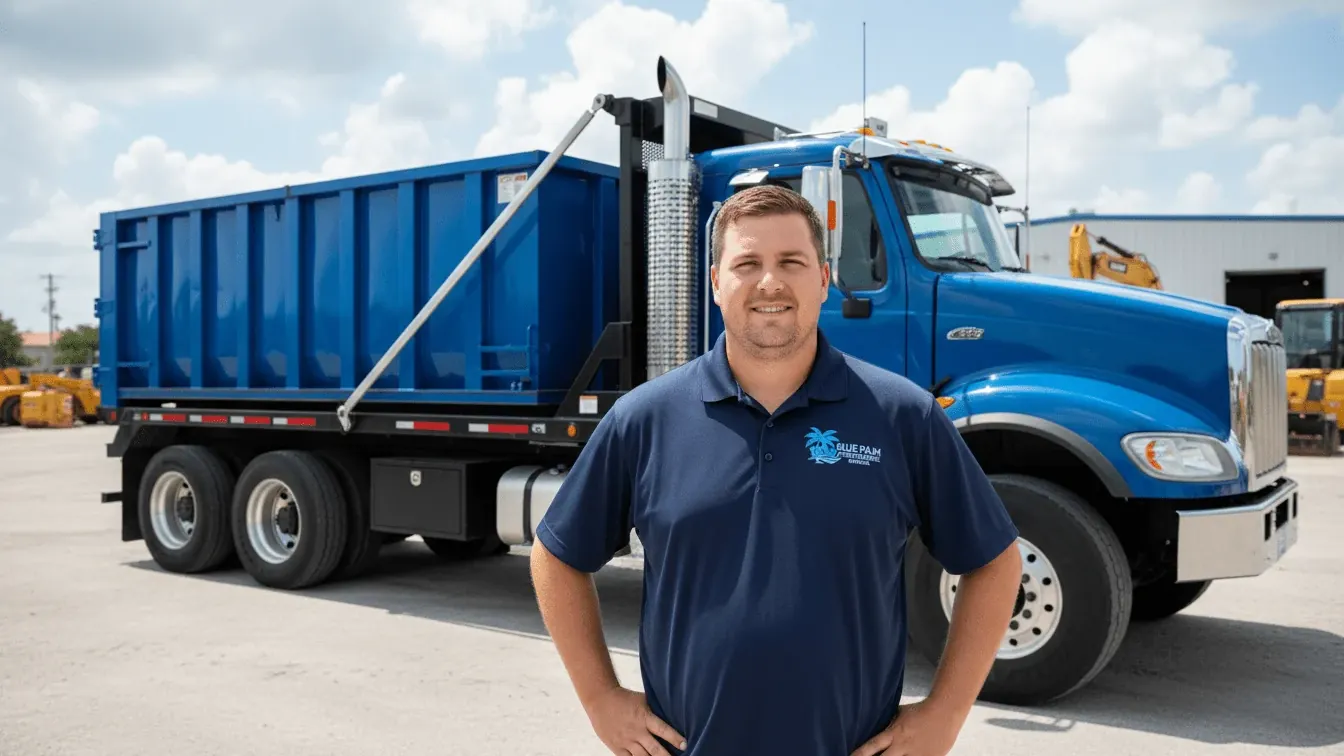
People ask what a dumpster costs in Sarasota the way they would ask what a gallon of gas costs. Fair question, unreasonable answer — a roll-off is not a product on a shelf. It is a truck, a driver, a round trip, a slot on the schedule, and a load weighed at a facility that charges by the ton. Change one of those and the number moves.
What follows is what actually moves it. Not a price list — you get a real number by calling with real details — but an honest account of the levers, so you can hear whether a quote holds up.
Flat rate versus the headline rate with the fees stacked on
Two pricing models exist in this trade. The first is a flat rate: one number, quoted up front, covering the job as described. The second is a low headline rate published to win the click, then line items stacked on the invoice — delivery, fuel, environmental, disposal, administrative, sometimes the protection boards under the rails. The advertised number was never the number. It was bait.
Blue Palm runs flat rate, and the reason is boring: we are local, in a market where people talk to each other. Contractors on Lakewood Ranch punch-outs, condo managers on Longboat Key, estate attorneys sending cleanout after cleanout. A surprise on an invoice costs more in lost repeat work than it ever collects. Brady Hollis started this company in 2017 and that policy has not changed. Flat rate does not mean nothing can change — it means anything that can is named out loud before the truck rolls, and it is something you control.
What the flat rate covers, and what sits outside it
A flat rate here bundles the whole cycle of a rental:
- Delivery, with protection boards under the rails as standard on any driveway, paver apron or shell drive.
- The rental window — the agreed number of days the container sits on site.
- A weight allowance in tons, stated in the quote and sized to the material.
- The haul — the return trip to pick the box up.
- Tipping fees at the facility for everything inside that allowance.
What sits outside it is short and specific: Florida sales tax where it applies, tonnage over the allowance, days past the rental window, and a dry run — a wasted trip where the truck cannot deliver or cannot pick up. Prohibited material is its own category, and our guide to what can go in a dumpster in Sarasota County lays that out. Asbestos-containing material is an absolute no in every box we own.
Weight is the biggest variable, and it is not close
Volume decides which box shows up. Weight decides what the load costs, and the material mix on a Sarasota job swings that wildly.
Dense material runs roughly 2,400 to 2,800 pounds per cubic yard: concrete, block, stucco, brick, terrazzo, ceramic and porcelain tile, sand, shell and clean fill. Terrazzo catches people out constantly — pull the carpet in a mid-century house off Bahia Vista and there is a poured stone floor under it, and a few rooms of it fills the weight allowance while the box still looks half empty. That is why we run dedicated concrete and heavy debris containers, and why the honest answer there is a small box loaded low rather than a big one loaded properly.
Roofing splits the same way. Architectural shingle is predictable. Concrete and clay tile run roughly three to four times the weight of a shingle square, and this market has plenty of tile on the older and higher-end stock. A tile tear-off that a mainland shingle guide would put in a 20 yard box belongs in something smaller with a bigger allowance — the whole point of our roofing tear-off sizing guide.
Then there is the one nobody plans for: wet storm debris, the single most underestimated weight in this market. Saturated drywall, soaked insulation, waterlogged carpet and pad, swollen cabinetry — material that weighed almost nothing dry comes out of a surge-flooded house at multiples of its dry weight. Helene taught a lot of people that in one week in September 2024. Green tree debris does the same: live oak is hardwood and sabal palm holds water. On a storm job, read our storm surge cleanup guide first, and tell whoever quotes you the material is wet.
Clean loads versus contaminated loads at the scale
Classification decides which facility a load goes to and what it charges. A clean, separated load — all concrete, all clean wood, all metal, all vegetative — can often be processed or recycled rather than buried. A load with one wrong item in it is a mixed construction load, full stop.
The rule that trips up the most people is Florida's separation of yard trash from solid waste. Vegetative debris rides as its own clean load to a yard-waste or mulching facility. Throw a few bags of drywall scrap and a broken lanai screen frame on top of the palm fronds and oak limbs and the whole thing gets reclassified at the scale: you paid to haul mulch and got billed for landfill. That is why we run yard waste removal as a separate container rather than an add-on. Accepted materials change at the county level, so confirm current requirements with Sarasota County or Manatee County first.
The cost drivers, in one table
| Driver | What it is | How to control it |
|---|---|---|
| Material density | Concrete, block, stucco, terrazzo, tile, sand and fill at roughly 2,400–2,800 lb per cubic yard. | Say “terrazzo” or “tile” on the call. Take a smaller box with a bigger allowance. |
| Moisture | Surge-soaked contents and green tree debris weighing multiples of their dry weight. | Tarp the box between loads and get wet material out fast. |
| Load classification | Clean separated load versus mixed contaminated load at the scale. | Keep vegetative, concrete and metal separate. One wrong item reclassifies everything. |
| Roof material | Concrete and clay tile at three to four times a shingle square. | Count squares and name the material before ordering. Stage the tear-off. |
| Container size | The wrong box means a second haul or a load that will not fit. | Describe the job, not the box. Compare the roll-off sizes first. |
| Rental window | Days on site past the agreed period. | Order when the crew is ready. Book a swap-out rather than holding a full box. |
| Dry runs | A wasted trip — blocked spot, locked gate, unapproved placement, overloaded box. | Cone the spot, confirm gate access, get board approval in writing. |
| Distance and access | Drive time to the service edges and onto the barrier islands. | Book earlier for island and far-south runs. |
| County and jurisdiction | Sarasota and Manatee run separate solid waste and permitting systems. | Give the street address, not the mailing city. Check whether a right-of-way permit applies. |
| Season and demand | Snowbird months, post-storm surges, sustained condo repair work. | Book ahead in season; standing schedules for multi-phase jobs. |
Dry runs: the avoidable charge
A dry run is the only charge here that produces nothing for anybody. What causes them on the Suncoast, and the fix for each:
- A car parked in the spot. The most common cause by a mile. Cone the spot the night before, or park something in it yourself and move it when the truck turns up.
- A locked gate. Gated communities east of I-75, storage yards, commercial lots. Give us the code or clear the truck with the guardhouse in advance.
- A condo board that never approved the placement. On Longboat Key, Siesta Key and downtown the association decides where a box may sit, and sometimes on which days. Get it in writing before you book, especially on milestone and SIRS repair work.
- A load heaped above the rails. Nothing rides above the top rail — it cannot be tarped and cannot legally go down the road. Load level and call for a swap.
- Prohibited material on top. Tyres, batteries, propane cylinders, paint, solvents and household chemicals stop a pickup cold. Those go to a county household hazardous waste drop-off instead.
- A soft sandy drive nobody mentioned. Sandy soil and a high water table are the norm here, and a loaded truck sinks. Tell us the surface. Protection boards go down as standard, but boards do not fix saturated ground.
- A low live oak limb. A roll-off truck needs real vertical clearance to raise the box. Walk the approach and look up.
Distance, access and the causeway problem
We run from 33rd Street East, just north of University Parkway near the airport, which puts the yard in Manatee County looking straight down into Sarasota. Most of the region is a short run. The edges are not: Venice, North Port and Englewood to the south, Parrish and Ellenton to the north are real drive time each way, and drive time is truck time.
The barrier islands are their own category. Siesta Key, Lido Key and Longboat Key mean causeway traffic that does not care about your schedule, then short shell or paver driveways, tight turnarounds and neighbours parked close. In season a mainland delivery and an island delivery are not the same job even in the same box. Our service areas page lays out coverage; book island work earlier and take the window we offer rather than the one you want.
Two counties, two disposal systems
Sarasota County and Manatee County run separate solid waste operations, and the City of Sarasota, Venice, North Port, Longboat Key, Bradenton and Palmetto add rules on top. Where a load can go, and what that facility accepts, depends on which side of the line the job sits on and what is in the box. A Lakewood Ranch address can be either county — one reason we ask for the street address rather than the city on the envelope. These programmes change, so verify anything specific with the county or with Florida DEP for regulated material.
Season moves the number too
Three demand cycles overlap here. Snowbird season runs November through April, with the crunch in the shoulder weeks at either end, when seasonal residents open up, clear out and close down inside the same fortnight — our seasonal cleanout guide covers that rhythm.
Hurricane season runs June 1 to November 30, and in the days after a named storm every container in the region is spoken for. That is not a pricing tactic, it is arithmetic: same fleet, ten times the demand, facilities at capacity. Watch Florida Division of Emergency Management guidance and get on a list early rather than calling on day three.
Underneath both runs the condo milestone inspection and SIRS repair workload — balconies, railings, walkways, spalling concrete, waterproofing and re-roofing across Sarasota, Longboat Key and Siesta Key. Those statutory requirements have been amended more than once, so an association should confirm its current obligations with its own attorney and engineer rather than any contractor's summary.
How to get an honest all-in number on the phone
Have these ready and you get a real quote in one call instead of a range and a callback:
- The street address, plus gate codes and community name.
- What the material actually is — say concrete, terrazzo, tile, roofing, wet contents or vegetation.
- Roughly how much: rooms, squares of roof, linear feet of driveway.
- Whether it is wet.
- Where the box sits and what the surface is.
- The dates and how long you need it.
- Anything unusual overhead or underfoot.
Then ask three questions straight out: is that the total, what is the weight allowance in tons, and what happens if I go over. A flat-rate operator answers all three without hesitating. If the answer to the first is anything other than yes, keep dialling.
Tell us what the job is and we will give you the all-in number on the call — flat rate, weight allowance stated, protection boards standard, same-day and next-day delivery across Sarasota and Manatee counties. Ring Blue Palm Dumpster Rental Sarasota at (941) 413-2932, or send the details through our contact page and we will come back with a number you can budget against.
Questions this guide did not answer? Call (941) 413-2932. We would rather spend two minutes on the phone than have you order the wrong container.