
Delivery
Driveway Protection During Dumpster Delivery in Sarasota
A loaded container bears down through two steel rails, not four tires. Here is how sandy soil, pavers, shell drives and summer rain change what a Sarasota driveway can take.
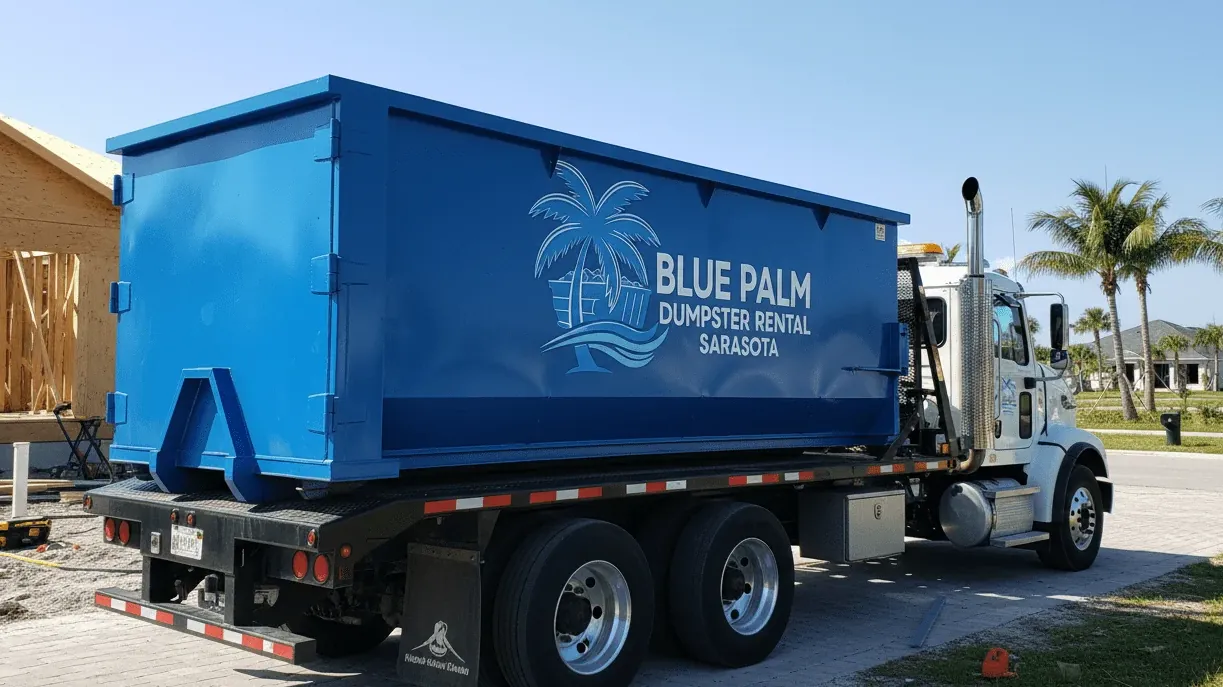
People picture a roll-off container sitting on the driveway the way a car does. It does not, and the difference is most of what keeps a Sarasota driveway in one piece.
A loaded 20-yard container and the truck carrying it do not spread weight the way four car tires do. The truck comes in heavy on a handful of tire patches, and the box lands on two steel rails running its full length plus four small wheels at the back. That is the entire contact area. Full of roof tile, block or wet drywall, all of that weight bears down through those rails onto a strip of surface a few inches wide. It is not the truck rolling past that marks a driveway. It is the rails and the wheels, loaded, sitting there for a week.
The physics, in plain terms
Concrete is strong in compression and weak under point loading. Residential driveway slabs here run four inches over compacted sand with light mesh or fibre, poured for passenger vehicles, not a concentrated line load. So the failures we see are almost never a crushed slab. They are edge chips at the apron, a hairline opening along a control joint, a settled section where the base gave way, or shallow ruts pressed into shell, sand or pavers.
The other half of the physics is what sits under the slab. Sarasota is sand with a water table a couple of feet down after a normal wet season and closer after a week of storms. Sand drains fast, but it also moves, and saturated sand under a driveway edge has very little bearing capacity. A truck that crosses your apron in March without a trace can push a corner down an inch in August. People are surprised by that because the surface looks dry. The surface is not the problem.
Protection boards are standard, not an upsell
Every delivery goes down on protection boards under the rails. It is not a line item and not something you have to ask for — it is simply how the box gets set. Boards spread that line load across a far wider footprint and give the driver a controlled surface to roll the box onto. On pavers, shell and stamped concrete we carry extra and lay a wider bed.
The second half of the routine matters as much: the driver photographs the surface on arrival, before the box comes off the truck. Existing cracks, spalling, oil stains, a settled paver, a chipped apron — all of it, timestamped. That is the one thing that ends an argument three weeks later about whether a crack was there before. Ask and we will send you copies.
Sarasota surfaces, and how each behaves
| Surface | Risk | What we do | What you can do |
|---|---|---|---|
| Poured concrete, sound | Apron edge chips, a hairline opening at a control joint | Boards under both rails, box square, wheels off the apron lip | Point out control joints if hard to see |
| Older slab, cracked or spalling | Cracks widen, a loose section settles or rocks | Photograph first, shift off the failed section, add board width | Flag the bad spots before delivery day, not after |
| Pavers (Lakewood Ranch, Palmer Ranch) | Units settle or tilt, bedding sand migrates, edge restraint pushes out | Wide board bed, straight-in approach, no turning under load | Add plywood over the boards for a long or heavy job |
| Shell or crushed shell (the keys) | Ruts, displaced shell, a low spot holding water | Wider bed, and we say so up front if it is soft | Keep shell on hand to top up after pickup |
| Sand or sand-over-grass drive | Both truck and box sink; recovery damages more than delivery | Walk it first, usually recommend the street instead | Get a street permit, or lay plywood yourself |
| Stamped or decorative concrete | Sealer scuffs and colour marks that do not come out | Wider bed so no steel touches the pattern | Say it is stamped when you book |
| Asphalt | Indentation in summer heat, soft into the evening | Wider boards, early delivery where the route allows | Keep the rental short if it was recently sealed |
| Grass, swale or unimproved ground | Deep ruts, crushed irrigation, a stuck truck | Generally decline and propose another spot | Clear a firm spot, or plan on street placement |
The keys: short drives, shell and salt
Siesta Key, Lido Key, Longboat Key and Casey Key are their own problem. Driveways there are short, sometimes barely twenty feet from street to garage, and many are shell, sand or paver rather than poured concrete. Add a water table close to the surface a few hundred feet from the Gulf and a beach-access lane a truck has to back down, and placement gets tight fast. On a short key drive a 10-yard container or a 15-yard container is usually the right call even when the job would justify more: less rail on your surface, shorter manoeuvre. We would rather do two swaps than force a 30 onto twenty-two feet of shell.
Salt air is the quiet one. Gate hardware and irrigation heads on the islands are already corroded, and a container brushing a post that has stood in salt air for fifteen years does not end well for the post.
Pavers deserve their own warning
Paver driveways are everywhere in the newer Lakewood Ranch and Palmer Ranch stock, and they are the surface owners are most attached to and least forgiving about. A paver drive is not a monolithic surface. It is thousands of units on bedding sand over compacted base, and concentrated load makes that sand migrate. The result is a settled or tilted paver — a repair with a plate compactor and fresh bedding sand, not something you scrub out. Pavers also chip at the corners when a steel wheel drops onto an edge rather than a face. We will not set a heavy-debris box on pavers without talking it through first: if you are filling a container with concrete, block or tile, your own sheets of three-quarter plywood on top of our boards are worth the trouble.
Rain, the days after, and hurricane season
From June into September the afternoon storm pattern is a daily fact, and a Gulf Coast downpour can drop two inches in an hour. The risk is not the rain. It is the two or three days after, when the surface looks fine and the sand under your driveway edge and swale is still soaked. That is when trucks leave ruts and slab edges settle. We will move a delivery a day rather than put a loaded truck on soft ground — recovering a stuck truck off a wet swale does far more damage than the delivery would have.
Hurricane season runs June 1 to November 30, and 2024 taught everyone here what that means. We will not leave a container on soft, saturated ground with a system in the Gulf. A loaded box can move in surge and throw debris in wind, and the ground beneath it is weakest exactly when the storm arrives. If something is developing, call and we will pull or swap it early. Our notes on storm surge and wind cleanup cover the container side in more detail, and Florida's emergency management division carries the official guidance.
Placement judgement: what is under the spot and over it
Level ground first — a box on a slope wants to roll, and the load shifts onto the low rail. Then back off the apron edge, the thinnest, least supported part of a residential slab and where chips start. And clear of the garage door swing, which gets missed more often than you would think.
What is buried matters as much. On east-county and Myakka-side properties septic is common, and a loaded roll-off does not go over a tank lid, a drain field or a well head; drain field failures from vehicle loading are expensive and slow to fix. Closer in, what gets crushed is sprinkler heads, shallow irrigation lines, landscape wiring and French drains. Sunshine 811 handles locates for buried public utilities, though it will not map your own irrigation.
Overhead, the hoist arm goes above 20 feet as the box comes off, so the clearance we need is well above the container's own height. The number-one overhead obstruction here is the live oak — Sarasota is full of mature ones with heavy low limbs over driveways, many of them protected trees you do not want trimmed casually. After that it is service drops from the pole, gutters and fascia at the garage, and lanai screen framing where a drive runs tight along a cage.
Approach, condos and street placement
The practical numbers: roughly 60 feet of straight run to set and pick up cleanly, and about 10.5 feet of width. Not 10.5 feet of pavement — 10.5 feet of clear space, counting mirrors, mailboxes, walls, palms and parked cars. A cul-de-sac or tight villa court eats that quickly, which is why we ask questions when you book roll-off delivery instead of finding out on the day.
A large share of the Suncoast has no driveway at all. In a condo or villa community the box goes in a parking area or drive aisle, which is association territory. Two approvals matter: the board, and often the fire marshal, since a container cannot block a fire lane or the path to a hydrant or riser. Get it in writing — a verbal nod from one board member will not help when a different one objects on day three. This comes up constantly on milestone inspection and structural repair work, where the box sits for weeks in a lot full of residents who still live there, so think about their parking and walking routes. Many 55+ communities also cap how many days a container may stay, a week being common, which drives your size choice and whether you plan a swap. Association rules vary and change, so confirm the current version with management.
Sometimes the right answer is to keep the box off your surface entirely and set it in the street. That protects the driveway but puts you in public right-of-way, and here that means asking the right authority: Sarasota County, Manatee County, the City of Sarasota, Venice, North Port, Longboat Key, Bradenton and Palmetto each answer for themselves, and a state road answers to FDOT. Our write-up on dumpster permits in Sarasota and Manatee County lays out who to call. Requirements do change, so confirm with Sarasota County or your city before you commit to a street spot.
What to do before delivery day
- Move the cars the night before.
- Mark the exact spot with cones, chalk or a couple of buckets and text a photo to the office. That one step prevents most placement problems.
- Unlock the gate or send the code, and confirm its width if it is tight.
- For a condo or villa, have the written board sign-off in hand, plus the fire-marshal note if one was needed.
- Tell us about anything soft, sandy, pavered, stamped, cracked or buried — septic, drain field, well head, irrigation, French drain, landscape wiring.
- Trim what you can overhead, and mention the live oak you cannot touch.
- Size for the surface, not just the pile. Our guide to choosing a dumpster size in Sarasota covers the trade-off, and a 20-yard box on a sound slab is the workhorse for most residential jobs.
Ten-odd years of running roll-offs on this coast has taught us that nearly every driveway problem is a placement problem, decided before the truck arrived. Tell us what your surface is, what is under it and what is over it, and we will bring the boards and the right box. Call Blue Palm Dumpster Rental Sarasota at (941) 413-2932 or reach us through the contact page — we cover Sarasota County, Manatee County and the barrier islands across our full service area, with boards on every delivery and a driver who will tell you honestly when your ground is not ready.
Questions this guide did not answer? Call (941) 413-2932. We would rather spend two minutes on the phone than have you order the wrong container.