Recycling
Recycling and Disposal in Sarasota County: Where It All Goes
A Suncoast operator on where Sarasota and Manatee County material actually ends up — clean loads versus mixed, yard trash rules, hazardous waste drop-offs, scrap, salvage and storm debris.
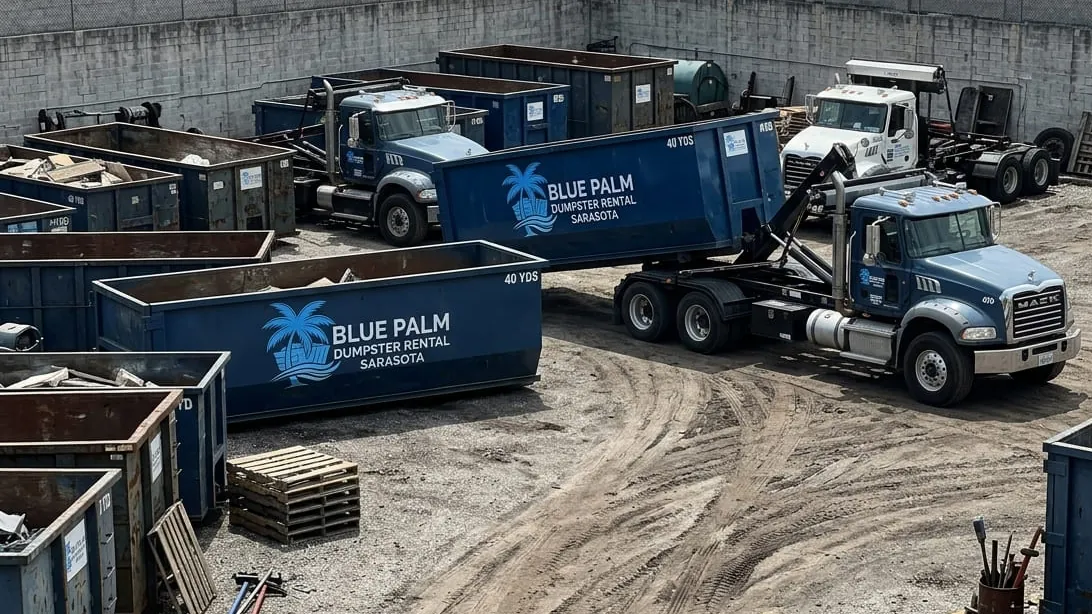
People ask me where it all goes. A container leaves a driveway on Bee Ridge Road or a job site out in Lakewood Ranch, gets weighed, looked at, and classified. That classification decides whether the material is crushed, ground, baled, melted down or buried — and it is decided by how the load was put together, not by anything afterwards.
Ten years of running roll-offs on both sides of University Parkway boils down to one sentence: a clean load of one material is worth something to somebody, a mixed load is worth nothing to anybody.
Four ways material leaves a property
- Curbside collection. Household garbage, the recycling cart and scheduled yard-waste pickup. Built for routine household volume. Pile a remodel or a downed live oak at the curb and the pickup gets skipped.
- A county drop-off or transfer site. Good for small one-off items you can haul yourself — a few tires, a television, a car battery, a box of fluorescent tubes. Limited by what fits in your vehicle and by residential limits.
- Household hazardous waste drop-off or event. The only correct destination for the chemical shelf: paint, solvents, pool chemicals, fuel, pesticides.
- A roll-off container. For real volume of solid material — a re-roof, a kitchen, a lanai rebuild, an estate cleanout, a storm pile. It also does what the other three cannot: run separate clean loads and actually recover material.
Most jobs use two or three at once. A mid-century remodel off Siesta Drive might be a concrete container, a mixed C&D container, one trip to hazardous waste, and a salvage buyer through the house first. Our guide to what goes in a Sarasota County dumpster has the accepted list.
Two counties, two systems
Our yard at 6805 33rd St E sits just north of University Parkway near the Sarasota-Bradenton airport, which puts us on the Manatee County side working Sarasota County every day. They are separate operations: different facilities, hours, accepted-item lists and hazardous waste schedules. The cities layer on again — Sarasota, Venice, Bradenton, North Port, Longboat Key and Palmetto run their own arrangements.
So an answer from a Manatee site does not necessarily hold at a Sarasota one. And plainly: hours, accepted items and event dates change, sometimes with little notice, and more often after a storm. Check current listings with Sarasota County or Manatee County before you drive across the line.
Yard trash is a separate stream
This is the rule that matters most here. Florida treats yard trash as its own category, distinct from solid waste, with a different destination. Vegetative debris goes to a yard-waste or mulching facility and comes back out as mulch or boiler fuel rather than buried. But only if the load is clean — branches, trunks, fronds and brush, nothing else. One bag of trash or a few sheets of plywood and the container is reclassified at the scale and landfilled as mixed debris.
Our tree debris is a specific mix: live oak, sabal palm, Australian pine and Norfolk Island pine, often all four off one property, behaving nothing alike. Palm fronds and trunk sections are bulky and wet but light per yard. Live oak is dense hardwood and puts a small container over weight long before it looks full. When we size a yard waste and vegetative debris container, the hardwood ratio drives it more than the pile height does.
Clean loads recover value, mixed loads do not
- Clean concrete, block and masonry gets crushed into fill, road base and driveway sub-base. This is block-and-stucco country, so a dedicated concrete and heavy debris container earns its keep.
- Clean untreated wood gets ground for mulch or fuel; treated, painted and engineered wood does not qualify.
- Metal goes to scrap — the most reliably recovered material on any job.
- Cardboard gets baled, which on a builder punch-out is a real share of the load.
- Mixed C&D gets picked over at a processing facility; the residual is buried.
Separation costs a little planning and sometimes a second container. Mixing costs the recovery, the tipping difference and occasionally a sorting charge. On construction and remodel work, two containers is usually the cheaper answer.
| Material | Best destination | What disqualifies it |
|---|---|---|
| Branches, trunks, palm fronds, brush | Yard-waste facility, ground for mulch | Trash, lumber, fencing or soil mixed in |
| Clean concrete, block, brick, terrazzo | Crushed for fill and road base | Dirt, wood, drywall or trash in the load |
| Untreated lumber and pallets | Ground for mulch or biomass fuel | Treated, painted, or still nailed to drywall |
| Roofing metal, gutters, aluminium framing | Scrap metal yard | Attached shingle, insulation or glass |
| Refrigerators, freezers, A/C units | Refrigerant evacuation, then scrap | Charge not recovered and documented |
| Shingle tear-off | Dedicated roofing load, C&D disposal | Tile, wood or gutters mixed in |
| Paint, solvent, fuel, pesticide, pool chemicals | County household hazardous waste drop-off | Never accepted in a container |
| Electronics, monitors, CRT televisions | County e-waste collection program | Broken CRT glass; mixed loads often refused |
| Tires | Dedicated tire recycling channel | On the rim at some sites; never in a container |
| Fibreglass hull, treated pilings, dock lumber | Specialised marine handling | Marine growth, saturated foam core, fuel residue |
| Asbestos-containing material | Licensed abatement contractor only | Cannot go in any container we own, ever |
Scrap metal: the easiest recovery on the job
Metal essentially always gets recycled, and a Suncoast job produces plenty — roofing metal off a keys re-roof, gutters, water heaters, appliances, ductwork, boat trailers and galvanised dock hardware. Two categories are specifically local. Lanai and pool cage aluminium comes off in long clean extrusions after a wind event and is about as good as scrap gets. Impact and old aluminium window frames are the other: that market is enormous here, and every job leaves a stack of stripped frames. Set a spot for metal before demo starts — once it hits the mixed container it is gone.
Make the salvage call before the skip
Sarasota has architectural history most Florida markets do not. The Sarasota School of Architecture — Rudolph, Twitchell, Lundy — left a body of 1940s to 60s houses across the city and the keys, and there is a real buyer market for what comes out of them: terrazzo, often hiding under carpet in a house nobody thinks is special, jalousie hardware, period lighting, original built-ins and breeze block.
I have watched plenty of that go into a container because nobody made one phone call. Make it. An hour of a salvage buyer's time before demo pulls out material with value and cuts what you pay to bury. Same logic on estate cleanouts and downsizing moves — furniture and tools with real resale value get thrown because the family is on a deadline.
C&D versus municipal solid waste
Two regulatory categories, two destinations. Construction and demolition debris is the inert material a building is made of: concrete, block, lumber, drywall, roofing, tile, glass, wiring. It goes to a C&D facility where much of it is recovered. Municipal solid waste is household material — food, packaging, textiles, furniture, junk — and takes a different path.
Put a few bags of kitchen trash in an otherwise clean demolition load and you have converted C&D into mixed solid waste at the scale. Same container, worse outcome, higher cost. On demolition work and junk removal, keeping those streams honest is the easiest saving available — more in our piece on construction debris disposal in southwest Florida.
Household hazardous waste, and no paint take-back here
The chemical shelf in the garage is what people get wrong. Paint and stains, thinners and solvents, gasoline, motor oil, antifreeze, pesticides, pool chemicals — chlorine, acid and shock, genuinely dangerous when they mix or get wet — batteries, fluorescent tubes, propane cylinders and old smoke detectors. None of it goes in a container. All of it routes through a Sarasota County or Manatee County household hazardous waste drop-off or collection event, generally free for residents with quantity limits.
Worth stating clearly, because people from out of state assume otherwise: there is no retail paint take-back scheme operating in Florida. The paint stewardship program that runs in other states does not operate here, so do not drive leftover paint to a hardware store expecting them to take it. The county is the answer. These programs change, so confirm current limits and dates, and check the Florida Department of Environmental Protection for anything unusual.
Electronics, refrigerant appliances, tires, mattresses
Electronics go through county e-waste collection: computers, printers, phones, flat panels and the old CRT televisions still coming out of garages and lanais here. CRTs carry leaded glass, are heavy, and are handled under a specific program.
Anything with a refrigerant charge — refrigerators, freezers, window and mini-split air conditioners, dehumidifiers — must have the refrigerant recovered by a certified technician first, a federal requirement under the Clean Air Act. Once documented, the carcass is scrap steel. Tires have their own channel and are banned from ordinary loads. Mattresses are increasingly handled separately, with their own fee and recovery route.
Boat and marine waste is its own category
We are a boating coast, and it produces a stream nobody plans for: old fibreglass hulls, rotted dock lumber, treated pilings, marine batteries and hardware coated in growth. Fibreglass is awkward — not clean wood, not metal, not really recoverable — and a saturated foam-cored hull is far heavier than it looks. Treated pilings cannot join a clean wood load; marine batteries are hazardous waste. Clearing a dock or seawall, say so on the booking call so we spec it right.
A declared storm changes the whole system
After a declared event the counties stand up emergency debris operations and normal rules are temporarily replaced. Right-of-way collection runs, and residents place debris at the curb sorted into separate piles — vegetative, construction and demolition, appliances, electronics, and household hazardous waste. Separate trucks collect each stream, which is why sorting matters: a mixed pile gets passed over, sometimes for weeks.
Sarasota and Manatee run these independently, with their own schedules and placement rules, so guidance shared online may be for the other side of the line. After Helene's surge and Milton's wind in late 2024, the properties cleared fastest sorted properly and used a container for what the right-of-way was never going to take — anything from inside the house, anything a contractor generated. Our storm surge cleanup guide covers the sequence, and Florida's emergency management agency posts guidance during an activation. Follow the county's live instructions over anything you read beforehand.
Why it matters on this coast
Sarasota Bay, Roberts Bay, Little Sarasota Bay and Phillippi Creek are all downstream of us. Stormwater reaches the water fast here — sandy soil, flat grades, a high water table, a rainy season that dumps volume in a hurry. Seagrass coverage and bay water quality are watched closely by the estuary program. That is why nothing gets stockpiled where runoff reaches water, why chemicals never sit in an open container through an afternoon storm, and why placement on waterfront and barrier island properties gets the attention it does.
Red tide is the other local reality. When a bloom moves inshore it brings its own beach and dock cleanup. Keeping paint, fuel, refrigerant and chemicals out of the waste stream is not paperwork here.
Keeping it simple
Three habits cover most of it: pull the metal, keep vegetation on its own, and take the chemical shelf to the county before the container lands. What is left is genuine container material. Whether that is a 10 yard for a heavy concrete load or a 30 for a whole-house clearout, tell us what is going in and we will say whether it wants one container or two.
Blue Palm Dumpster Rental Sarasota is locally owned, licensed and insured, and has answered Sarasota and Manatee County disposal questions since 2017. Same-day and next-day delivery, next-day swap-outs, protection boards, flat-rate pricing. Call Brady and the crew at (941) 413-2932, tell us what the job is, and we will get you the right container and a straight answer on what belongs in it.
Questions this guide did not answer? Call (941) 413-2932. We would rather spend two minutes on the phone than have you order the wrong container.